On-Page SEO: A Complete Guide to Optimizing Your Website
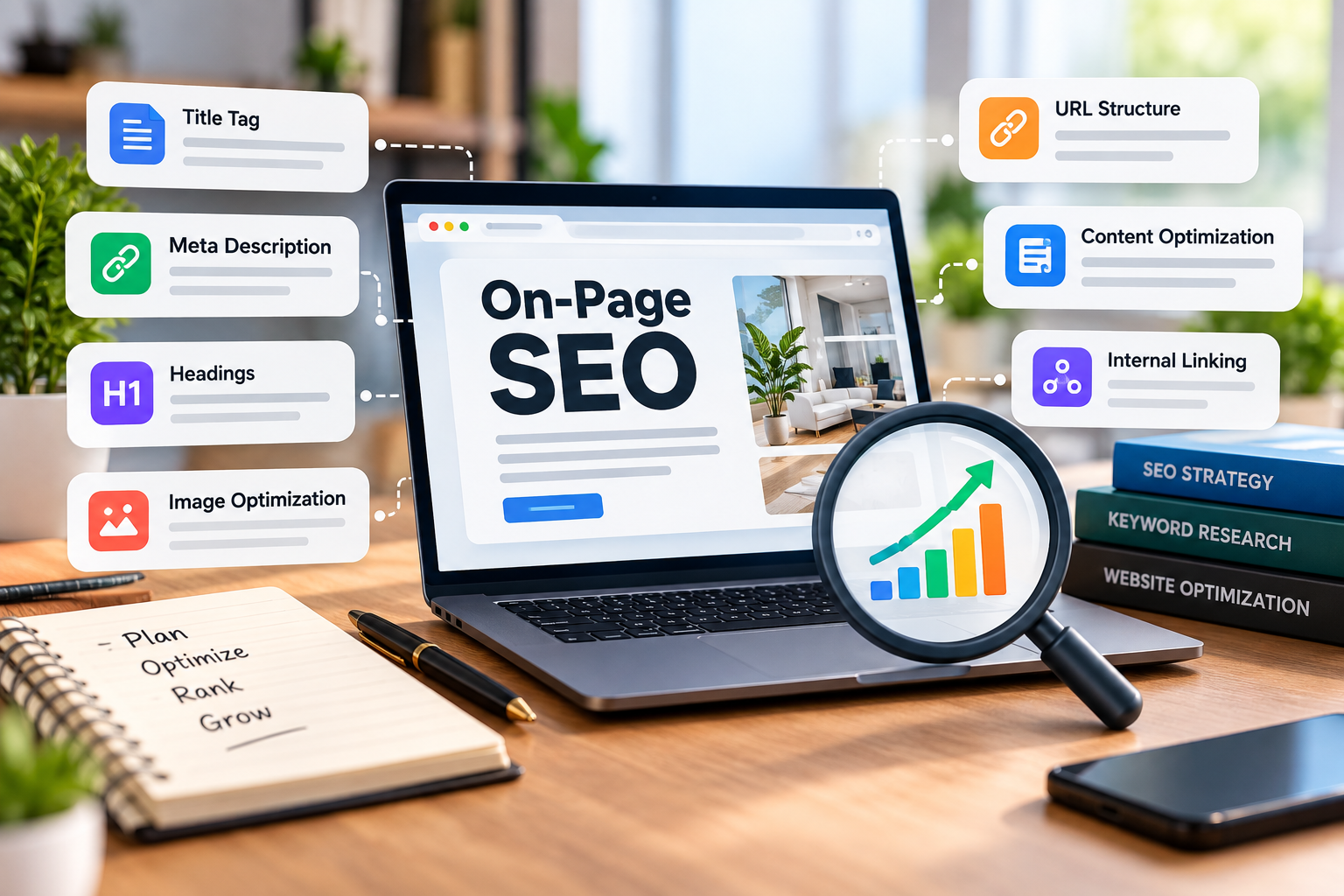
If you’ve ever published a page, waited a few weeks, and watched it sit quietly on page 4 of Google — the problem usually isn’t your content idea. It’s what’s happening on the page itself. That’s where a solid on page seo service earns its keep, and it’s also the one part of SEO you have complete control over. You don’t need permission from another website, a journalist, or an algorithm update. You just need to get the fundamentals right, consistently, page after page.
This guide walks through exactly what on-page SEO means in 2026, how it actually works, and the full checklist you (or your team) can run through on every page you publish — including how it’s changed now that people search through AI tools like ChatGPT and Google’s AI Overviews, not just the traditional blue links.
What Is SEO, and Where Does On-Page SEO Fit In?
Before we go deep into on-page tactics, it helps to zoom out. If you’re new to SEO as a whole, our guide on What Is SEO? is a good place to start — it covers the three main pillars: on-page, off-page, and technical SEO.
On-page SEO specifically is the practice of optimizing everything that lives inside your webpage — your headings, your copy, your images, your internal links — so that search engines and AI tools can understand what the page is about and confidently show it to the right person. Off-page SEO, by contrast, is what happens outside your site: backlinks, brand mentions, reviews. You’ll see how the two compare in the diagram below
How Does On-Page SEO Work?
For a deeper breakdown of the mechanics, we’ve covered this in detail in How Does SEO Work? — but in short: search engines and AI models crawl your page, read its structure and content, and try to match it to what a person is actually asking for. On-page SEO is how you make that match obvious.
When your title tag, headings, and body copy consistently point to the same topic — and that topic genuinely answers the searcher’s question — you’re giving both Google’s crawler and an AI model like ChatGPT clear signals to work with. Get this wrong, and even genuinely useful content can get overlooked simply because the page never made its relevance clear.
On-Page SEO vs. Off-Page SEO
It’s worth being clear about where the boundary sits, since the two often get lumped together.
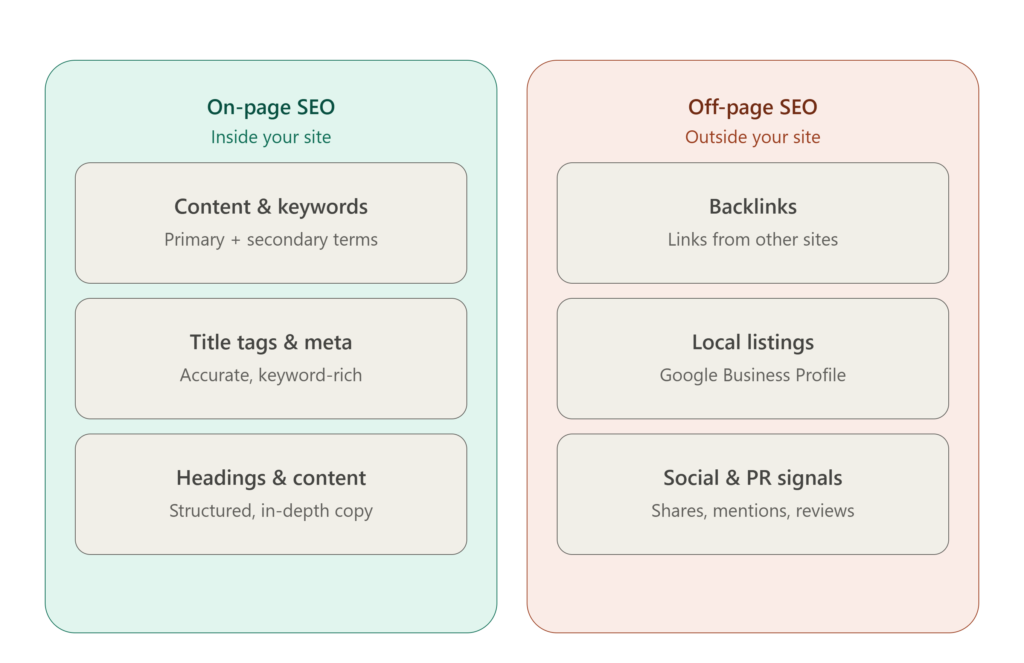
The short version: on-page is everything you can directly control on the page; off-page is everything that happens elsewhere and depends on how other sites and people talk about you. Both matter, but on-page is where every SEO strategy should start — you don’t need to wait on anyone else to fix it.
Keyword Research Comes First
None of the tactics below work without solid keyword groundwork. We’ve written a full walkthrough in Keyword Research, but the short version here: figure out what your audience is actually typing (or asking AI tools) before you touch a single headline. For this article, for example, the anchor is on page seo service, with on page seo service in Trivandrum and seo service in Trivandrum layered in for local intent — more on why that split matters further down.
The Complete On-Page SEO Checklist for 2026
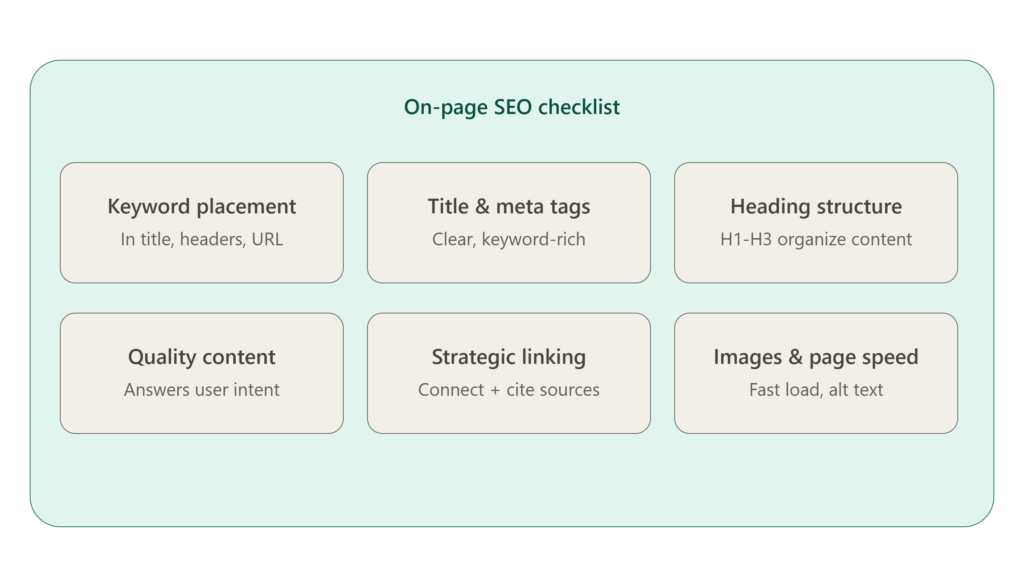
Here’s everything that goes into a genuinely well-optimized page, broken into the areas that matter most right now.
1. Place your target keywords strategically
Your primary keyword should show up in your H1, your first paragraph, at least one subheading, your URL slug, and your image alt text — naturally, not forced. If a sentence reads awkwardly because you crammed a keyword into it, rewrite the sentence. Search engines (and readers) can tell the difference between relevance and stuffing.
2. Write accurate, compelling title tags
Keep title tags between 50–60 characters so they don’t get cut off in results. Include your primary keyword close to the front, and keep it close to your H1 so there’s no disconnect between what someone clicks and what they land on.
3. Optimize your URL slug
Short, readable, and keyword-inclusive. /on-page-seo-complete-guide tells a search engine — and a human — exactly what’s on the page before they even click.
4. Write a meta description that earns the click
Meta descriptions don’t directly boost rankings, but they heavily influence whether someone chooses your result over a competitor’s. Keep it under roughly 155 characters, include the keyword, and give the reader a reason to click — not just a restatement of the title.
5. Structure your content with proper headings
Use H1 for your title, H2s for your main sections, H3s for subpoints. This isn’t just for readability — AI search tools pull individual sections out of context to answer questions, so each section needs to make sense entirely on its own, with the heading answered clearly in the sentence right below it.
6. Create genuinely useful, complete content
This is the part most checklists gloss over. Cover the topic thoroughly enough that a reader doesn’t need to open a second tab. Answer the obvious follow-up questions before they’re asked. If you have real experience or data that a competitor’s page doesn’t, that’s what separates a page that ranks from one that doesn’t.
7. Add internal links (like the ones above)
Link to your other relevant content — it helps readers go deeper and helps search engines discover and understand your site’s full topic coverage. Use descriptive anchor text, not “click here.”
8. Add external links to credible sources
Linking out to authoritative, relevant sources builds trust and gives readers somewhere to go for more depth. For instance, Semrush’s own guide to on-page SEO is a solid technical reference if you want to go even deeper on any of these points, and Google’s own SEO Starter Guide is worth bookmarking as a primary source.
9. Write descriptive image alt text and file names
Rename IMG_4021.jpg to something like on-page-seo-checklist.jpg, and write alt text that actually describes the image — this helps with image search and accessibility, and it’s a natural, low-effort spot to work in a keyword where relevant.
10. Optimize for page speed
A slow page loses people before they ever read your carefully optimized content. Compress images, use modern formats like WebP, and cut unnecessary redirects.
11. Add schema markup
Structured data (Article schema, FAQ schema, Local Business schema) helps search engines understand your content’s context and can unlock rich results — star ratings, FAQ dropdowns, and more visibility in the SERP.
On-Page SEO for AEO and GEO: What’s Changed in 2026
Two years ago, on-page SEO meant optimizing purely for Google’s crawler. Today, a meaningful share of searches happen through AI tools — ChatGPT, Perplexity, Google’s AI Overviews — and that’s given rise to two newer disciplines sitting on top of traditional SEO:
- AEO (Answer Engine Optimization) — structuring content so AI tools can lift out a clean, direct answer. This means answering the question in the first sentence after a heading, avoiding vague pronouns (“it,” “this”) in favor of restating the subject clearly, and keeping each section self-contained since AI models often extract individual paragraphs out of context.
- GEO (Generative Engine Optimization) — making your content the kind of source generative AI tools actually choose to cite. That comes down to demonstrated expertise, up-to-date information (AI tools show a clear preference for recently updated pages), and original insight that doesn’t just repeat what’s already ranking.
Practically, this means the old checklist above still holds — but you’re now also writing for a machine that’s trying to summarize you accurately to someone who may never click through to your site at all. Treat every H2 as a question your reader might type into ChatGPT, and answer it plainly underneath.
On-Page SEO Service in Trivandrum: Why Local Businesses Need It
If you’re a business owner in Kerala, generic on-page SEO advice only gets you halfway. Someone searching for an seo service in Trivandrum or looking specifically for an on page seo service in Trivandrum is showing strong local intent — and Google treats that differently from a broad, non-local search.
For local businesses, on-page SEO needs a few extra layers on top of everything above: working “Trivandrum” or your specific neighborhood naturally into titles, headers, and body copy where it’s genuinely relevant; embedding a Google Map and your NAP (name, address, phone) consistently across pages; and pairing your on-page work with Local Business schema markup so search engines can confidently connect your site to your physical location. Done well, this is often the fastest way for a Trivandrum-based business to start showing up for people who are ready to buy, not just browse.
How to Measure On-Page SEO Success
On-page SEO isn’t a one-and-done task — it’s worth tracking:
- Keyword rankings for your target terms over time
- Organic traffic to the specific pages you’ve optimized, via Google Analytics
- Click-through rate from Google Search Console
- AI Overview and featured snippet appearances, which are becoming just as important as traditional rankings
If a page isn’t moving after a few weeks of solid on-page work, that’s usually a sign to revisit search intent — you may be answering a slightly different question than what people are actually asking.
Why Work With an On-Page SEO Service
Doing all eleven checklist items above, consistently, across every page on a site — while also tracking AEO and GEO signals — is genuinely a lot to manage alongside running a business. That’s exactly the gap a dedicated on page seo service fills: auditing existing pages, fixing what’s underperforming, and building new content that’s optimized from the first draft instead of retrofitted later.
Frequently Asked Questions
On-page SEO is the practice of optimizing the content and structure of a webpage — its text, headings, images, and links — to help search engines and AI tools understand it and match it to relevant searches.
Yes — if anything, it matters more now. AI search tools rely heavily on well-structured, clearly written on-page content to generate accurate answers and citations.
Most sites start seeing measurable movement within four to twelve weeks, depending on competition, site authority, and how significant the changes were.
Conclusion
On-page SEO isn’t a one-time checklist you run and forget — it’s the ongoing discipline of making sure every page on your site clearly earns its place in search results, for both traditional search engines and the AI tools increasingly standing between you and your reader. Start with the fundamentals: keywords, structure, genuinely useful content. Then layer in AEO and GEO thinking, and if you’re a local business, don’t skip the location-specific work. Get all of that right consistently, and the rankings tend to follow.