What Is SEO? A Complete Guide to Search Engine Optimization

If you’ve ever typed a question into Google and wondered how certain websites always show up first, you’ve already bumped into the idea behind SEO. So, what is SEO? In simple terms, SEO (Search Engine Optimization) is the practice of shaping your website so that search engines — and increasingly AI tools like ChatGPT, Gemini and Google’s AI Overviews — can find it, understand it, and recommend it to people searching for what you offer, without you paying for ads.
Whether you’re running a small business website, a personal blog, or handling marketing for a growing company, understanding what SEO is and how it works is the first real step toward getting found online. In this guide, we’ll walk through what SEO means, why it matters, how search engines (and AI answer engines) actually work, and how you can start applying it — even if you’re a complete beginner.
What Does SEO Stand For?
SEO stands for Search Engine Optimization — the process of improving a website so it appears more often, and more prominently, in the unpaid (organic) results of search engines like Google and Bing. The goal is simple: when someone searches for something related to your business, your page should be one of the ones they find, click, and trust.
A page’s visibility usually comes down to three things:
- Relevance — how well your content actually answers what the searcher wants
- Authority — how trustworthy and credible your site appears to search engines
- Structure — how easily a search engine (or an AI crawler) can read and understand your pages
Why Is SEO Important?
SEO matters because it builds visibility that keeps working long after you’ve done the work — unlike ads, which stop the moment you stop paying for them. A few reasons businesses invest in SEO:
- It brings in visitors who are already searching for what you offer, which usually means better quality leads
- It doesn’t cost anything per click, unlike paid search or social ads
- It builds long-term authority and trust, since organic results are generally seen as more credible than ads
- It’s becoming even more important as people increasingly ask AI tools questions instead of typing them into a search bar — and those tools still pull their answers from well-optimized websites
How Do Search Engines Actually Work?
Before you can optimize for search engines, it helps to know what they’re doing behind the scenes. It generally happens in three stages:
- Crawling — Search engines send out automated bots (“crawlers”) that discover pages across the web, mostly by following links from one page to another.
- Indexing — Once a page is found, the search engine analyzes it and, if it meets the bar, stores it in a massive database of possible search results.
- Ranking — When someone searches, the engine looks at their intent and pulls out the most relevant, trustworthy pages from that index to display.
AI-based answer engines work a little differently. Instead of handing you a list of links, tools like ChatGPT or Google’s AI Overviews read your question, pull relevant information from multiple sources, and write a single answer — often citing a few of those sources directly. That shift is exactly why SEO has expanded to include two newer ideas: AEO and GEO.
SEO vs AEO vs GEO — What’s the Difference?
SEO (Search Engine Optimization) is the umbrella term for improving visibility in organic search — traditionally, ranking well on Google’s results page.
AEO (Answer Engine Optimization) focuses on getting your content picked as the direct answer — in featured snippets, voice search results, or a quick AI-generated summary. This usually means writing clear, direct answers near the top of your content, in plain language.
GEO (Generative Engine Optimization) is about getting mentioned or cited inside AI-generated responses from tools like ChatGPT, Gemini, and Perplexity. It leans heavily on structured content, original insights, and being seen as a credible source — since these tools tend to cite pages that are already well-regarded.
In practice, all three overlap more than they differ. Good SEO — helpful content, a clean site structure, and real authority — is still the foundation AEO and GEO are built on. If you want a deeper dive into how AI search is reshaping this space, Semrush’s guide to what SEO is is a solid, detailed read on the topic.
|
1. On-Page SEO
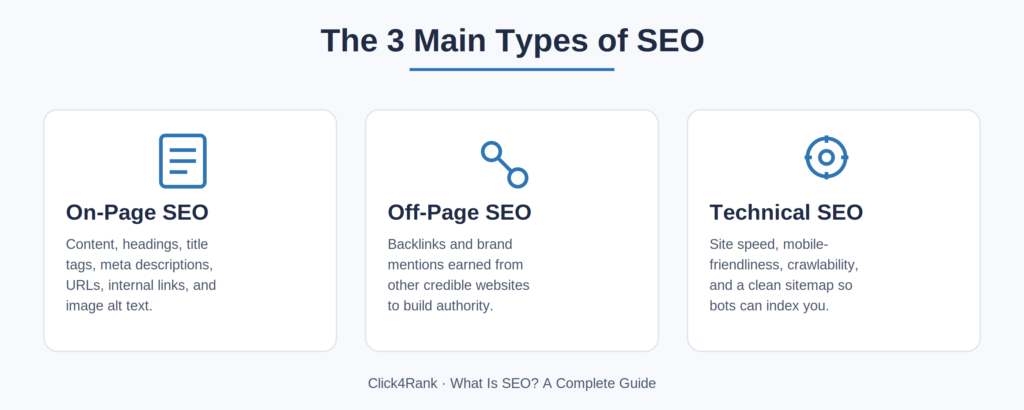
On-page SEO covers everything you control directly on your own pages — your content, headings, title tags, meta descriptions, URLs, internal links, and image alt text. It’s about making each page genuinely useful and easy for both readers and search engines to understand.
2. Off-Page SEO
Off-page SEO is everything that happens away from your site to build its reputation — mainly earning backlinks and mentions from other credible websites. When trusted sites link to you, search engines (and AI tools) treat that as a vote of confidence.
3. Technical SEO
Technical SEO makes sure your site is fast, mobile-friendly, and easy for search engines to crawl and index in the first place. Even the best content won’t rank if bots can’t access or load your pages properly.
How to Get Started With SEO: 5 Core Steps
- Do keyword research. Find out what your audience is actually searching for, so you’re creating content people are looking for — not guessing.
- Create genuinely useful content. Match the format to what the searcher wants, and aim to cover the topic better than what’s already ranking.
- Optimize your on-page elements. Work your target keyword naturally into your title tag, meta description, headings, URL, and body copy — without forcing it.
- Fix technical issues. Check site speed, mobile usability, and make sure your important pages are easy to crawl and index.
- Earn links and track results. Build genuine backlinks and brand mentions over time, then keep an eye on your rankings, traffic, and conversions to see what’s working.
Need Professional SEO Help in Trivandrum?
Not every business owner has the time — or the patience — to handle all of this in-house, and that’s completely normal. If you’d rather hand it off, working with an experienced SEO service in Trivandrum can save you months of trial and error.
If you’re a startup, a small business, or a solo founder looking for a freelance SEO service in Trivandrum that actually understands both the technical side of SEO and the local Kerala market, Click4Rank offers full-range support — keyword research, on-page and technical audits, content, and local SEO — built around what actually moves the needle for businesses trying to get found online.
Frequently Asked Questions
SEO is the practice of improving your website so it shows up more often and more prominently in search results, without paying for ads — by making your content relevant, your site trustworthy, and your pages easy for search engines to understand.
SEO doesn’t involve paying for clicks the way ads do, but it isn’t entirely free — it takes time, and often some investment in content, tools, or hiring an SEO service, to do well.
Most websites start seeing meaningful movement within a few months, though timelines vary depending on competition, site age, and how consistently the work is done. SEO is a long-term strategy, not an overnight fix.
SEO is about ranking well in traditional search results, while AEO (Answer Engine Optimization) is about getting picked as the direct answer — in a featured snippet, a voice search result, or an AI-generated summary. AEO builds on the same foundation as SEO.
You can absolutely learn the basics and do it yourself, especially for a small site. But if you want faster, more consistent results — or simply don’t have the time — working with a freelance SEO service in Trivandrum like Click4Rank can be a practical middle ground between DIY and hiring a large agency.